How Novāscend
Helps
From uncertainty to deliberate movement
When familiar career tactics or greater effort do not resolve the underlying question, doing more may not be the most useful place to begin.
The work becomes understanding what needs attention, what matters now, and what kind of movement could help you make a more informed decision.
Novāscend approaches that work through three connected conditions:
How Novāscend
Helps
From uncertainty to deliberate movement
When familiar career tactics or greater effort do not resolve the underlying question, doing more may not be the most useful place to begin.
The work becomes understanding what needs attention, what matters now, and what kind of movement could help you make a more informed decision.
Novāscend approaches that work through three connected conditions:
Stability → Direction → Momentum
They are not three rigid stages. You do not have to complete Stability before considering Direction or taking action. More than one condition may need attention at the same time, and changing circumstances may shift where your attention is most useful.
The aim is not perfect calm, permanent certainty, or constant activity. It is to create enough Stability to understand your situation, enough Direction to choose or test what matters now, and Momentum through action that serves a clear purpose.
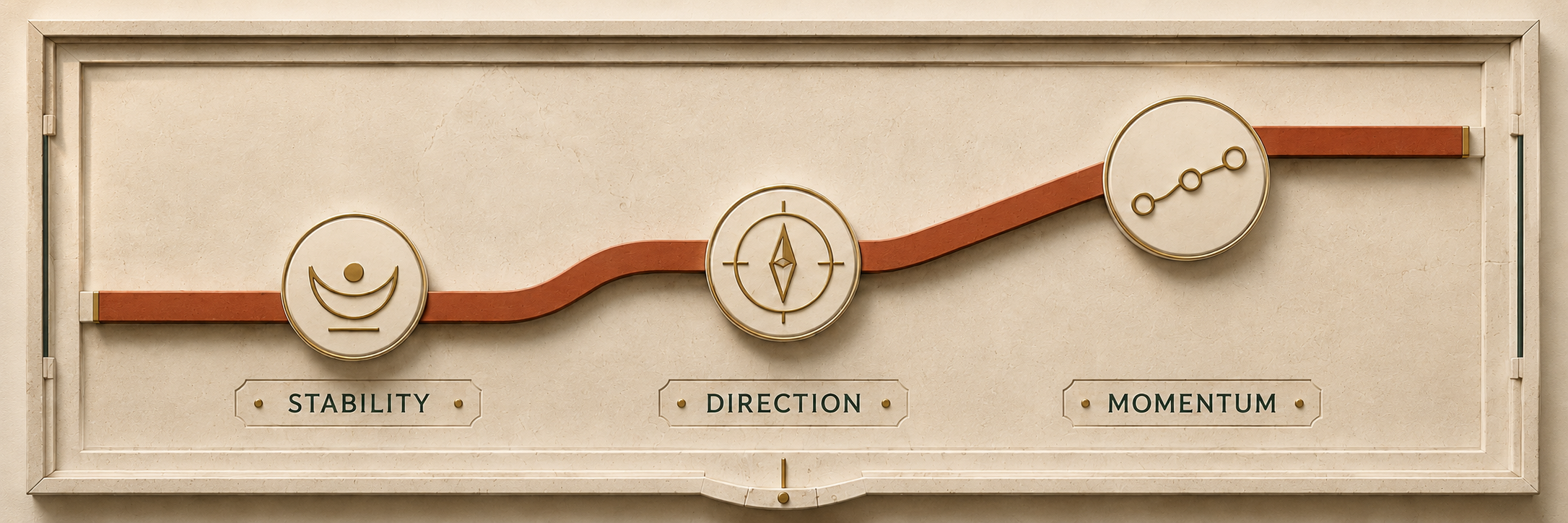
Stability → Direction → Momentum
They are not three rigid stages. You do not have to complete Stability before considering Direction or taking action. More than one condition may need attention at the same time, and changing circumstances may shift where your attention is most useful.
The aim is not perfect calm, permanent certainty, or constant activity. It is to create enough Stability to understand your situation, enough Direction to choose or test what matters now, and Momentum through action that serves a clear purpose.
You do not need complete certainty before moving, but movement should help you learn.
You do not need complete certainty before moving, but movement should help you learn.
What each condition makes possible

Stability
Respond with greater steadiness and perspective
Professional uncertainty can make every question feel urgent. Immediate pressures, competing priorities, and incomplete information may narrow your perspective or pull your attention in several directions.
Stability means having enough steadiness to see what is happening, consider what needs attention now, and account for the circumstances and constraints shaping your choices. It creates room for a more deliberate response, even when the situation itself remains unsettled.
Enough Stability does not mean achieving perfect calm or resolving everything before you act. It means having sufficient perspective to decide how to respond.

Direction
Decide what matters now
Direction is not one permanent answer about the rest of your career. It is enough clarity to choose or test a current priority, decision, possibility, or hypothesis.
That might mean determining which question deserves attention first, identifying a possibility worth examining, or deciding what you need to learn before making a larger commitment.
Direction gives action a purpose. It helps you move from “I need to do something” toward a more useful question: “What am I trying to understand, decide, or change now?”
Your direction may develop as you learn. It does not need to be irrevocable to be useful.

Momentum
Turn direction into focused action
Momentum develops when action serves a current purpose.
Applications, conversations, research, training, and greater effort may all be useful in the right context. But volume alone does not establish progress. What matters is whether an action helps you pursue a priority, test an assumption, understand a constraint, or inform a decision.
Momentum is not activity for its own sake. It is movement with a reason.
What each condition makes possible
Stability
Respond with greater steadiness and perspective
Professional uncertainty can make every question feel urgent. Immediate pressures, competing priorities, and incomplete information may narrow your perspective or pull your attention in several directions.
Stability means having enough steadiness to see what is happening, consider what needs attention now, and account for the circumstances and constraints shaping your choices. It creates room for a more deliberate response, even when the situation itself remains unsettled.
Enough Stability does not mean achieving perfect calm or resolving everything before you act. It means having sufficient perspective to decide how to respond.
Direction
Decide what matters now
Direction is not one permanent answer about the rest of your career. It is enough clarity to choose or test a current priority, decision, possibility, or hypothesis.
That might mean determining which question deserves attention first, identifying a possibility worth examining, or deciding what you need to learn before making a larger commitment.
Direction gives action a purpose. It helps you move from “I need to do something” toward a more useful question: “What am I trying to understand, decide, or change now?”
Your direction may develop as you learn. It does not need to be irrevocable to be useful.
Momentum
Turn direction into focused action
Momentum develops when action serves a current purpose.
Applications, conversations, research, training, and greater effort may all be useful in the right context. But volume alone does not establish progress. What matters is whether an action helps you pursue a priority, test an assumption, understand a constraint, or inform a decision.
Momentum is not activity for its own sake. It is movement with a reason.
Novāscend's Flourishing Architecture
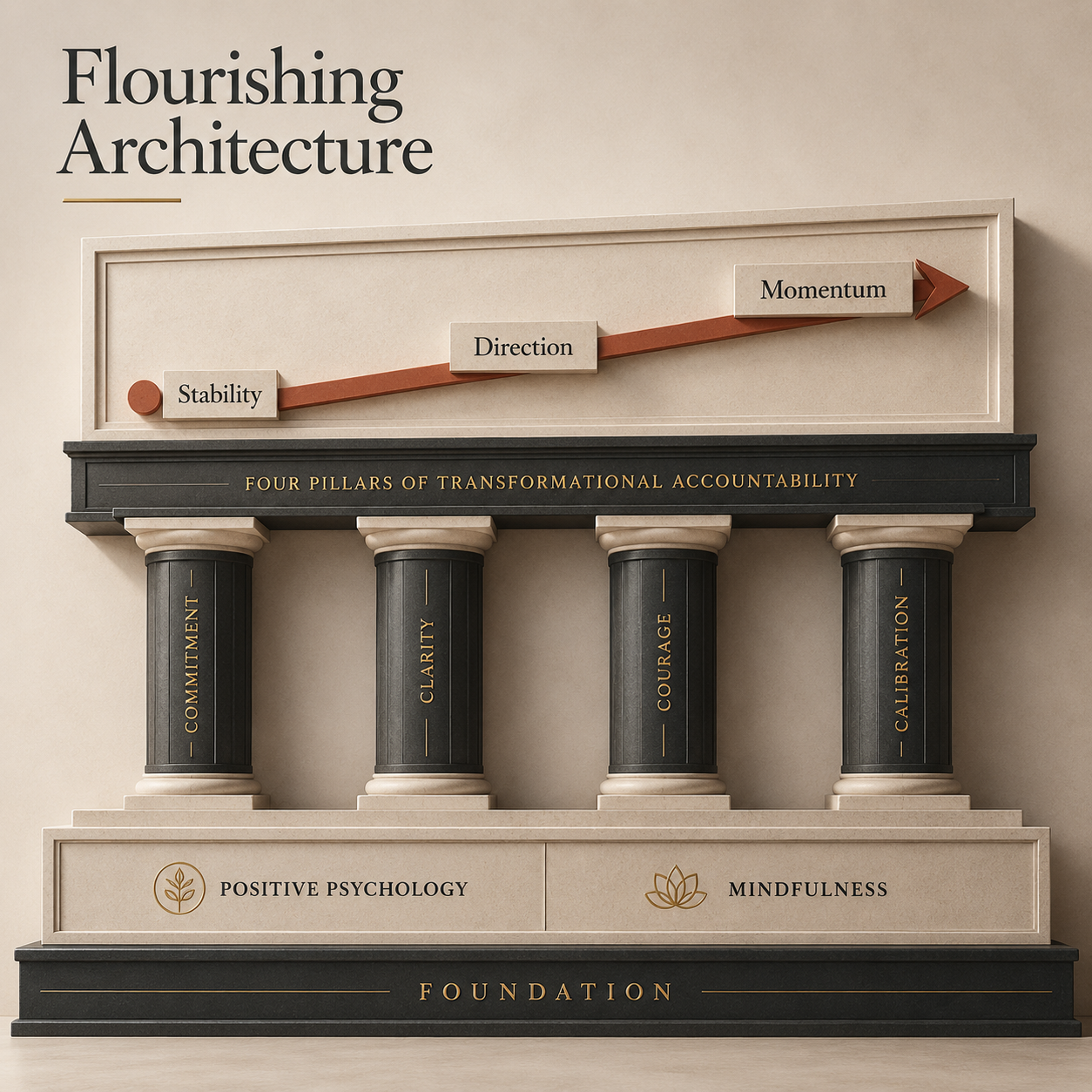
Stability → Direction → Momentum is the path forward.
Novāscend’s Flourishing Architecture is the structure that helps that path hold.
The architecture has two parts:
-
The Foundation: Positive Psychology and Mindfulness
-
The Pillars: Transformational Accountability — Commitment, Clarity, Courage, and Calibration
Novāscend's Flourishing Architecture
Stability → Direction → Momentum is the path forward.
Novāscend’s Flourishing Architecture is the structure that helps that path hold.
The architecture has two parts:
-
The Foundation: Positive Psychology and Mindfulness
-
The Pillars: Transformational Accountability — Commitment, Clarity, Courage, and Calibration
The Foundation
The Foundation is informed by Positive Psychology and Mindfulness. Together, they shape how Novāscend approaches attention, perspective, well-being, deliberate response, and the realities of moving through uncertainty—reinforcing the inner conditions that can support clearer decisions and purposeful action.
The Foundation is not about pretending things are fine. It is about developing enough steadiness and perspective to engage reality more effectively.

Positive Psychology
It helps identify the conditions that support well-being, resilience, meaning, strengths, engagement, relationships, and accomplishment. In a professional transition, these conditions matter because uncertainty can narrow attention, drain energy, weaken confidence, and make decisions feel heavier than they are.

Mindfulness
Mindfulness supports attention, awareness, and deliberate response. It helps create enough space to notice what is happening internally and externally, listen more carefully to the inner voice that can be hard to hear under pressure, distinguish facts from assumptions, and respond with greater steadiness rather than reacting only from urgency or fear.
The Foundation
The Foundation is informed by Positive Psychology and Mindfulness. Together, they shape how Novāscend approaches attention, perspective, well-being, deliberate response, and the realities of moving through uncertainty—reinforcing the inner conditions that can support clearer decisions and purposeful action.
The Foundation is not about pretending things are fine. It is about developing enough steadiness and perspective to engage reality more effectively.
Positive Psychology
It helps identify the conditions that support well-being, resilience, meaning, strengths, engagement, relationships, and accomplishment. In a professional transition, these conditions matter because uncertainty can narrow attention, drain energy, weaken confidence, and make decisions feel heavier than they are.
Mindfulness
Mindfulness supports attention, awareness, and deliberate response. It helps create enough space to notice what is happening internally and externally, listen more carefully to the inner voice that can be hard to hear under pressure, distinguish facts from assumptions, and respond with greater steadiness rather than reacting only from urgency or fear.
The Four Pillars of Transformational Accountability

Commitment
Choosing what deserves sustained attention and translating that choice into action.

Clarity
Developing a better current understanding of the question, evidence, assumptions, priorities, and next decision.

Courage
Taking warranted action despite uncertainty or discomfort, without ignoring risk or forcing action for its own sake.

Calibration
Using what happens as evidence to decide what to continue, modify, pause, or change.
Flourishing Architecture in Action
-
When Stability needs attention, the Foundation may matter most: steadiness, perspective, well-being, and awareness.
-
When Direction needs attention, Commitment and Clarity often become central: what matters now, what is known, what is assumed, and what decision or hypothesis deserves focus.
-
When Momentum needs attention, Courage and Calibration help turn direction into purposeful action, evidence, learning, and adjustment.
Different elements may become more important at different moments. The work is not rigid. The architecture gives the process enough structure to remain grounded while still adapting to the person’s real circumstances.
The Four Pillars of Transformational Accountability
Commitment
Choosing what deserves sustained attention and translating that choice into action.
Clarity
Developing a better current understanding of the question, evidence, assumptions, priorities, and next decision.
Courage
Taking warranted action despite uncertainty or discomfort, without ignoring risk or forcing action for its own sake.
Calibration
Using what happens as evidence to decide what to continue, modify, pause, or change.
Flourishing Architecture in Action
-
When Stability needs attention, the Foundation may matter most: steadiness, perspective, well-being, and awareness.
-
When Direction needs attention, Commitment and Clarity often become central: what matters now, what is known, what is assumed, and what decision or hypothesis deserves focus.
-
When Momentum needs attention, Courage and Calibration help turn direction into purposeful action, evidence, learning, and adjustment.
Different elements may become more important at different moments. The work is not rigid. The architecture gives the process enough structure to remain grounded while still adapting to the person’s real circumstances.
You remain the decision-maker
Novāscend brings structure and perspective to the process without prescribing your destination. It offers disciplined questions, helps distinguish assumptions from evidence, and helps connect decisions with action and learning.
You bring what only you can: knowledge of your circumstances, priorities, and constraints; judgment about the tradeoffs involved; and authority over your final decisions and direction.
Some important conditions—within employers, markets, institutions, and the wider environment—remain outside your control. The work takes those realities seriously while focusing attention on the decisions, actions, and responses you can reasonably influence. It does not treat every outcome as a matter of effort or attitude.
The approach is structured, practical, and evidence-informed. That describes the discipline brought to the process, not a promise of a particular result. Its purpose is to help you engage with uncertainty more deliberately while keeping ownership of your professional decisions where it belongs: with you.
You remain the decision-maker
Novāscend brings structure and perspective to the process without prescribing your destination. It offers disciplined questions, helps distinguish assumptions from evidence, and helps connect decisions with action and learning.
You bring what only you can: knowledge of your circumstances, priorities, and constraints; judgment about the tradeoffs involved; and authority over your final decisions and direction.
Some important conditions—within employers, markets, institutions, and the wider environment—remain outside your control. The work takes those realities seriously while focusing attention on the decisions, actions, and responses you can reasonably influence. It does not treat every outcome as a matter of effort or attitude.
The approach is structured, practical, and evidence-informed. That describes the discipline brought to the process, not a promise of a particular result. Its purpose is to help you engage with uncertainty more deliberately while keeping ownership of your professional decisions where it belongs: with you.
See how you can work
with Novāscend
When you are ready to explore what working with Novāscend could involve, the next step is to review the available ways to work together.
Explore Ways to Work TogetherSee how you can work
with Novāscend
When you are ready to explore what working with Novāscend could involve, the next step is to review the available ways to work together.
Explore Ways to Work Together